

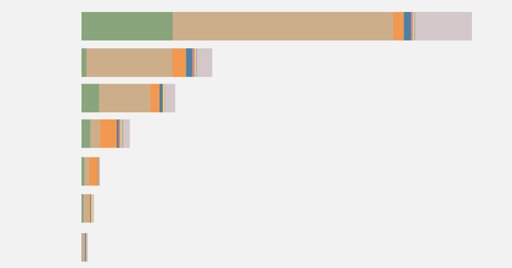
Food production is responsible for one-quarter of the world’s greenhouse gas emissions.
Eating locally would only have a significant impact if transport was responsible for a large share of food’s final carbon footprint. For most foods, this is not the case.
Greenhouse gas (GHG) emissions from transportation make up a very small amount of the emissions from food, and what you eat is far more important than where your food traveled from.
For most foods — and particularly the largest emitters — most GHG emissions result from land use change (shown in green) and from processes at the farm stage (brown). Farm-stage emissions include processes such as the application of fertilizers — both organic (“manure management”) and synthetic; and enteric fermentation (the production of methane in the stomachs of cattle). Combined, land use and farm-stage emissions account for more than 80% of the footprint for most foods.
Transport is a small contributor to emissions. For most food products, it accounts for less than 10%, and it’s much smaller for the largest GHG emitters. In beef from beef herds, it’s 0.5%.

The concept of a personal “carbon footprint” was popularized by oil companies to refocus attention away from their responsibility for climate change
To keep my carbon footprint low I dont buy from oil companies
That one step is the one they were trying to avoid with the rest of this non-sense. You’re not going to make up the difference for others not doing the same, with this stuff, or telling others to do this stuff.
And now those people are the ones crying about fuel prices while I don’t give a shit because I don’t even want it.
I just refuse to budget more for fuel when its more expensive. Gimme an excuse to refuse to leave the house because I don’t have the fuel in my car to drive across town for whatever non-sense and still make it to work until pay-day, I’m going to take it.
Suppose I do this too, just that my budget is always zero
I mean, yes, but the point I was making is that most people don’t, and so demand doesn’t adjust to supply or pricing quite as-it-should. I’ve got a few more payments to make on the vehicles I have before EV’s become anything-like a feasible option for me.
It’s a useful tool, but you are correct that everything is overwhelmingly dominated by primary use of fossil fuels.