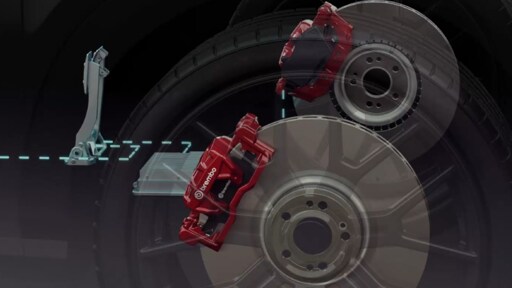
Brembo’s new “Sensify” braking system takes that one step further, eliminating the hydraulic system entirely and relying instead purely on electronic brake-by-wire and electric motors.
ok but…y tho?
Brake rotors are $500-$1500/set, pads are $50-$200/set, Friction and rust welds are common enough to damage other parts of the knuckle over the expected life time meaning that bill can easily turn into a $2k-$5k repair, totaling the car depending on the age.
Eliminating regular maintenance costs and production costs for a system that works essentially just as well (and can work better in an emergency if you don’t care about saving the associated motors) means cheaper cars, both upfront and over time, with the only downside being luddites afraid that two decades of EV data from a few dozen million cars isn’t enough to prove safety versus hydraulic.
In fact, according to BMW, drivers of current EVs pretty much never activate their mechanical braking systems, relying instead on their electric motors to handle the job.
I didn’t think the regen could bring a car to a complete stop, like at a stop sign or a red light. They’re certainly not using the motors to hold your place on a hill, are they?
Or are they just saying BMW drivers never stop when they’re supposed to?
In Formula E, they mostly brake with regen so much so that they completely did away with rear brakes. Whether or not current road cars can do the same I do not know. But from what I have heard many electric cars have problems with their brakes because they are used soo infrequently.
.
plus it saves you money on wear parts, because bypassing the hydraulic system means bypassing the pads and rotors too.
I replace my 911 rotors and pads once every 6 years? They cost $450 for the semi track compound.
These things ain’t saving anybody a dime but the manufacturer.
That’s just bad anecdotal evidence. A 2001 jetta, a full pad and rotor swap can be done for sub $200, a 2020 silverardo the rears alone will cost about $800, a 2010 gmc Acadia will run about $1100 for all four. And this could be from every year to every 6 years based on how many km are put on a given year.
And you really think even at a grand it’ll save you anything? Very few people outside of sports cars are replacing brakes that often. It’s like buying a 70k new EV to “save money” on gas with some copium that you’ll be the 3% to own the car for more than 6 years.
On ice vehicles this is dumb. Hard and expensive to repair for a brake pedal that feels like shit. Absolutely fucks the secondary and third owners looking for a cheap simple car to keep running.
Tell me you live in a flat unpopulate ddesert without telling me you live in a flat unpopulated desert. If you’re the 85% of humanity that lives along a coast you are not getting away with replacing your rotors any less than once every couple of years.
Love how people in this post believe THE brake manufacturing company, single supplier for virtually all competition-level vehicles, not to mention billions of road vehicles, are a bunch of dumbasses who can’t design a different version of their MAIN PRODUCT.
.
Right now there’s also not any failsafes for the break lines failing
deleted by creator
But this is the same as just having a split electrical circuit to a brake-by-wire solution. It’s only a pseudo-redundant system because you still rely on a single type of mechanical connection to brakes.
deleted by creator