

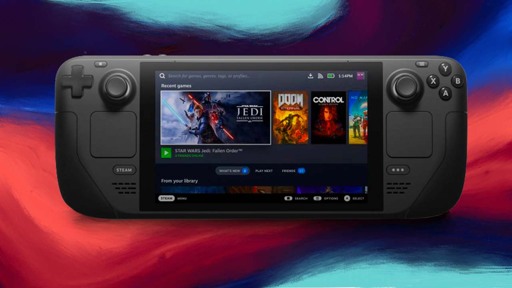
Valve recently raised the price on the Steam Deck, making the handheld gaming PC cost up to $949 for the 1TB OLED model. While that’s a massive $300 increase over its original price, the Steam Deck is once again sold out.
Valve recently raised the price on the Steam Deck, making the handheld gaming PC cost up to $949 for the 1TB OLED model. While that’s a massive $300 increase over its original price, the Steam Deck is once again sold out.
People are now conditioned to need INSTANT GRATIFICATION FOR EVERYTHING ALWAYS!
“I want a Steam Deck! I can’t actually afford these new prices! I’m buying it anyways!”
Then retailers see the insane prices people pay for stuff without blinking. Steam Decks sell out after a 40% markup. RAM & SSDs & HDDs sell out at 4x what they sold for a year ago. So the prices never go back down.
And everyone goes full surprised-Pikachu-face when everything is now always goddamn expensive.
Show some fucking restraint for once, people!
Goddamn.
So, the bottleneck here is really the memory prices, and while Steam Deck sales do affect memory prices — as with anyone buying anything with memory — my guess is that it’s a pretty small factor relative to other devices using memory.
According to WP, the Steam Deck has 16GB and sold uh, 4 million units over its entire lifetime as of February this year. It’s been out for four years. So figure ~64 petabytes of DRAM over its lifetime, or ~16 petabytes of DRAM per year.
For comparison, in a single year, looking at smartphones:
https://wifihifi.com/1-25b-smartphone-units-produced-in-2025-apple-samsung-tied-for-tops/
https://counterpointresearch.com/en/insights/Global-Smartphone-Average-DRAM-Hits-Record-8.4GB-in-2025
8.4 GB is the per-phone average, including older phones, so this is probably a conservative estimate, but assume for 2025, that meant that phone manufacture consumed ~10,500 petabytes of DRAM in a single year.
EDIT: And I’m sure that AI consumers dwarf that, given announcements about how much OpenAI alone was buying 40% of global capacity.
EDIT2: And if one wants local LLMs — I’d like to run my LLMs locally, not have some cloud provider do it — and you assume maybe 1% capacity utilization, then we’re going to need something like 100 times what the cloud AI companies are getting in RAM to get to that point.
So, yeah, Steam Deck purchasers do count towards demand for memory, but…I don’t think that they likely move the needle all that much alone.
you haven’t read anything about credit cards and the 20th century, have you? how old are you? like 19?
I was 19 in the '90s.
When nobody paid $20 to have GrubHub deliver their $5 McDonalds order from down the street to their house.
you mean when people were so impatient that they spent money to call an actual person to demand a pizza delivery in under 30 mins, then demanded it was free if it was one minute late, and if it was on time, paid for it with a credit card that charged interest?
We tipped the delivery driver a few bucks for deliveries.
I’m saying that there weren’t businesses where the entire model was: “Pay 2-3x what this food’s worth in-store, and some rando will deliver it. They may even give you everything you ordered.”
As we have seen, they won’t and never will. This is arguing for gravity to stop pulling so hard.
The mechanism to fix the problem you’re describing has broken long ago and everyone stopped trying to fix it. Your money needs more choices of where to be spent, then businesses will force each other to price things reasonably. If anyone can name all the companies that make a type of product, then that is not enough companies.
I posit it’s a consumer culture issue.
Look at Temo, Tiktok, Amazon, YouTube; people are bombarded with “buy this on impulse!” every day, 24/7, through notifications. They’re urged to buy high by dozens of influencers they’re bombarded with.
So they do.
And now that’s the culture. Competition isn’t going to fix that, and doesn’t naturally arise in that kind of environment anyway.
I think that’s true. I think that stems from the fact that a large percentage of global consumption is American in origin, and since at least the Industrial Revolution, that country’s culture has been led around by the nose by business magnates to the point that our national culture has remained relatively shallow compared to other nations and is largely centered around buying things, as you point out.
Yep, you can’t fix stupid.
The thing is… I’m lucky enough to be able to afford all of this. In part, because I avoid terrible-value purchases. When the price of something goes up 40 to 400% percent, I say to myself, “Wow, it’d be really stupid to buy that thing RIGHT NOW.”
Too many people apparently lack that critical judgment, and just have FOMO in its place.
People really underestimate how much money other people have. $950 is expensive, but there are so many people out there who can afford that.
Our economy has been running on debt for a long time now, and debt is a bottomless pit.
Also I speculate that these were almost definitely picked up mostly by scalpers.
We don’t live in a progressive society that almost universally pans impulse buys, unfortunately.